The Work in Greece & Macedonia: Eutychus & the Ephesian Elders
Acts 20
Acts 20
Acts 20. This chapter traces Paul’s final movements among the Gentile assemblies before heading toward Jerusalem. In vv.1-5, he travels through Macedonia and Greece, strengthening the saints and gathering a company of trusted companions. In vv.6-12, we see the assembly meeting to break bread at Troas, and to benefit from Paul’s teaching, as well as the fall and raising of Eutychus. After the southward journey toward Miletus (vv.13-16), the chapter closes in vv.17-38 with Paul’s moving farewell to the Ephesian elders. In this important discourse we have a review of Paul’s faithful ministry, warnings of coming danger, and the two great resources always available to the church of God.
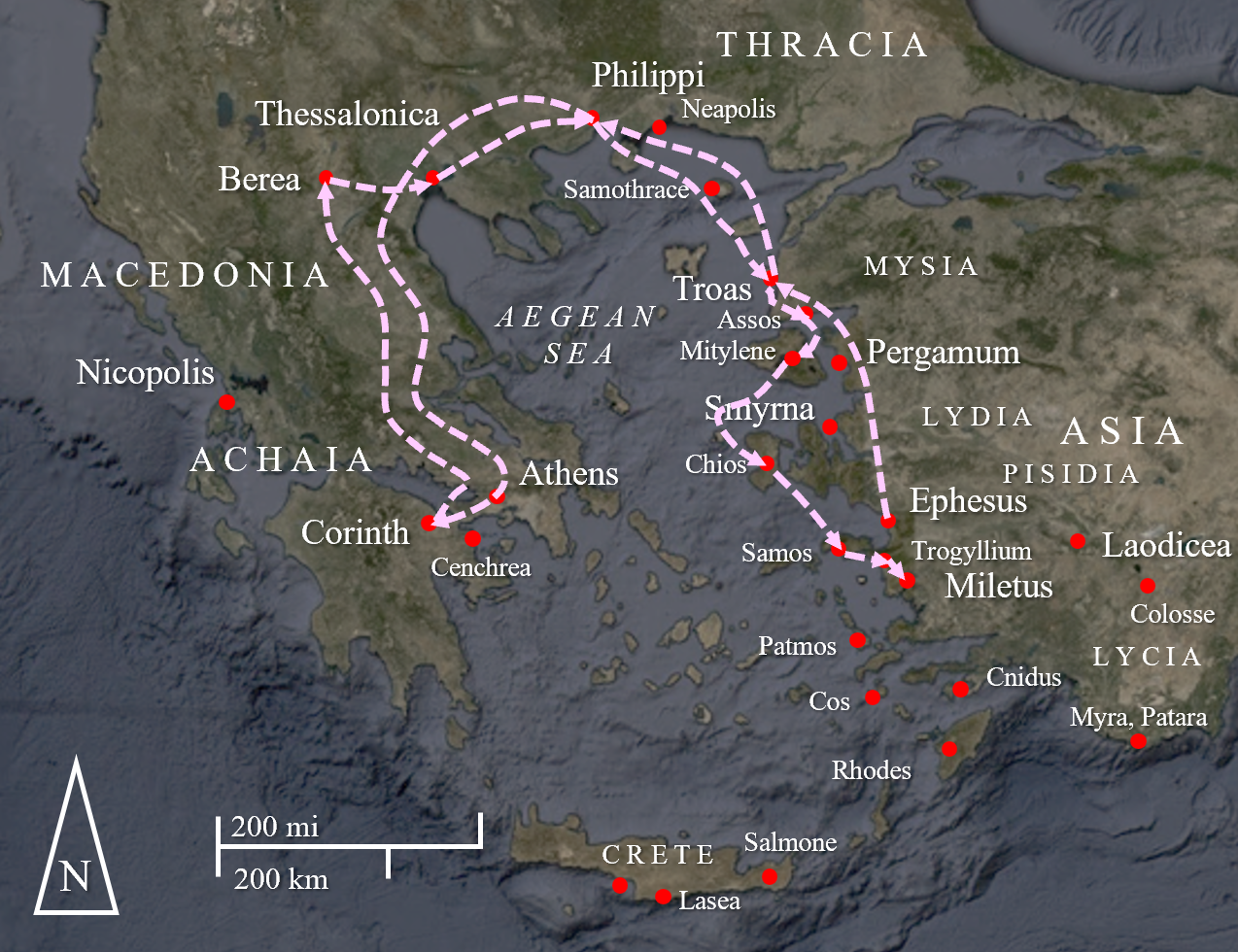
Paul in Macedonia and Greece (20:1-5)
CHAPTER 20
1 But after the tumult had ceased, Paul having called the disciples to him and embraced them, went away to go to Macedonia. 2 And having passed through those parts, and having exhorted them with much discourse, he came to Greece. DARBY
vv.1-2 Paul’s Journey Through Macedonia. After the riot in Ephesus subsided, Paul gathered the disciples, encouraged them, and departed toward Macedonia. Paul first stopped briefly at Troas, but this is not mentioned by Luke here. Paul speaks of it in 2 Cor. 2:12-13, that at Troas he had a tremendous opportunity in the gospel. But when he came to Troas, Paul did not remain long, because he had not rest in his spirit, for Titus had not arrived. He was restless to know the Corinthians’ state. Paul was so concerned for the Corinthians that he walked away from an attractive opportunity in the gospel, and left Asia altogether to come into Macedonia. Paul did not miss the Lord’s mind in this, because we see in 2 Cor. 2:14 that the Lord was leading him. Opportunities for ministry do not dictate our path. The Lord did not give Paul rest about the matter of Corinth, until he met Titus in Macedonia. Reaching Macedonia, he moved through “those parts”, including towns like Philippi, Thessalonica, and Berea. All the while, he was still troubled in spirit until Titus arrived with the report that the Corinthians had corrected the matters addressed in his first letter. This phase of travel shows the apostolic pattern of strengthening existing assemblies: Paul “exhorted them with much discourse,” combining pastoral care with the written ministry of his epistles. It was the continuation of a wide pastoral circuit, where Paul’s labors were marked by humility, tears, and perseverance amid persecution from the Jews (v.3).
3 And having spent three months there, a treacherous plot against him having been set on foot by the Jews, as he was going to sail to Syria, the resolution was adopted of returning through Macedonia. DARBY
v.3 Paul in Greece. Arriving in “Greece,” meaning Achaia (southern), Paul came to Corinth as he had promised (1 Cor. 16:3-5). Happily, this visit did not require “a rod” as would might have been necessary, and lasted three months, during which Paul wrote the Epistle to the Romans. But the unbelieving Jews, who probably remembered his earlier ministry there (Acts 18), plotted to kill him as he prepared to sail for Syria. They apparently intended to attack him on the voyage. Paul responded with practical sobriety: rather than take ship from Corinth, he altered his plan and returned overland through Macedonia, avoiding their ambush. Paul is a good example of spiritual energy and discernment amid danger.
4 And there accompanied him as far as Asia, Sopater son of Pyrrhus, a Berean; and of Thessalonians, Aristarchus and Secundus, and Gaius and Timotheus of Derbe, and of Asia, Tychicus and Trophimus. 5 These going before waited for us in Troas; DARBY
vv.4-5 Paul’s Companions. Luke records seven coworkers who joined Paul as he moved north through Macedonia: Sopater of Berea, Aristarchus and Secundus of Thessalonica, Gaius of Derbe, Timothy, and the two Asians, Tychicus and Trophimus. These men attached themselves to Paul’s work in Macedonia, likely at Philippi, and then traveled ahead to Troas to prepare for the ongoing ministry there. It is an amazing display of unity and fellowship in the early Church: diverse brethren from different regions laboring together in one work. Luke’s shift from “they” to “we” indicates that he himself rejoined Paul at this point after several years apart.
Paul in Troas: Eutychus (20:6-12)
6 but we sailed away from Philippi after the days of unleavened bread, and we came to them to Troas in five days, where we spent seven days. 7 And the first day of the week, we being assembled to break bread, Paul discoursed to them, about to depart on the morrow. And he prolonged the discourse till midnight. 8 And there were many lights in the upper room where we were assembled. DARBY
vv.6-8 Paul Comes to Troas: Breaking Bread, His Long Discourse. Paul and Luke sailed from Philippi after the days of Unleavened Bread, taking five days to reach Troas, a journey that normally took two. Arriving at Troas, they found the seven companions already there and remained seven days so as to be present with the assembly on the first day of the week, when the disciples gathered to break bread. This would suggest that it was the ordinary Christian pattern to have the Lord’s Supper on the Lord’s Day. In the early Church the breaking of bread, rather than preaching, was the primary purpose of the gathering (1 Cor. 11:20). The evening meeting time may have been due to secular obligations in their pagan environment. Paul’s extended discourse after the breaking of bread also shows that there may be opportunity for ministry following that assembly meeting. The fact that the saints remained together as Paul discoursed until midnight shows the spiritual appetite of those early assemblies. The “many lights” refers to candles or lamps that were burning to keep the upper room where they were assembled.
9 And a certain youth, by name Eutychus, sitting at the window-opening, overpowered by deep sleep, while Paul discoursed very much at length, having been overpowered by the sleep, fell from the third story down to the bottom, and was taken up dead. 10 But Paul descending fell upon him, and enfolding him in his arms, said, Be not troubled, for his life is in him. 11 And having gone up, and having broken the bread, and eaten, and having long spoken until daybreak, so he went away. 12 And they brought away the boy alive, and were no little comforted. DARBY
vv.9-12 Eutychus’ Fall and Raising Up. During Paul’s long discourse, a young man named Eutychus, seated in a window, drifted into a deep sleep and fell from the third story. He was taken up dead. What a shock this would have been to the happy company! It was a precarious place for a tired young man to be sitting so late in the evening. There may be an application in this, that when one tires of Paul’s ministry, they will eventually fall to the level of the world. Paul went down, embraced Eutychus, and he was restored to life. By application we see in this that recovery is accomplished going to the fallen one in love, conveying that the Lord and the saints still care; “enfolding him in his arms”. Afterward Paul returned upstairs, took some food for his own refreshment, and continued speaking informally until dawn. This meal was not a repetition of the Lord’s Supper but simply Paul’s personal need being met after a long night. The brethren, having witnessed the boy raised from the dead were “not a little comforted”. Even accidents and failures can be turned by God into occasions for blessing.
The Journey from Troas to Miletus (20:13-16)
13 And we, having gone before on board ship, sailed off to Assos, going to take in Paul there; for so he had directed, he himself being about to go on foot. DARBY
v.13 To Assos: By Land and By Sea. From Troas, the others sailed to Assos while Paul went on foot across the peninsula, a walk of roughly twenty miles. Perhaps Paul sought solitude with the Lord, being deeply occupied with the seriousness of his circumstances, conscious that bonds awaited him (v.23). This inner turmoil likely influenced his choice to travel alone. The group reunited at Assos, where Paul joined the ship for the continuation of the journey southward.
14 And when he met with us at Assos, having taken him on board, we came to Mitylene; 15 and having sailed thence, on the morrow arrived opposite Chios, and the next day put in at Samos; and having stayed at Trogyllium, the next day we came to Miletus: 16 for Paul thought it desirable to sail by Ephesus, so that he might not be made to spend time in Asia; for he hastened, if it was possible for him, to be the day of Pentecost at Jerusalem. DARBY
vv.14-16 From Assos to Miletus. Rejoining his companions at Assos, Paul sailed with them to Mitylene, then past Chios, Samos, Trogyllium, and finally reached Miletus. Miletus was an important Greek city on the western coast of Anatolia (modern-day Turkey). Paul deliberately bypassed Ephesus, not because of indifference, but because he was “hastening” to be in Jerusalem for Pentecost. Miletus was close enough to Ephesus for the elders to come to him without delaying his schedule. We see that Paul was fixed in his purpose: he pressed forward despite repeated dangers and prophetic cautions, intending to complete his course as he had determined it to be.
Farewell to the Ephesian Elders (20:17-38)
17 But from Miletus having sent to Ephesus, he called over to him the elders of the assembly. DARBY
v.17 Paul Calls for the Ephesian Elders. From Miletus, Paul sent to Ephesus and summoned the elders of the assembly to meet him. Paul had a special, solemn word for these men because he believed they would not see his face again and because he foresaw coming decline after his departure. Paul chose Miletus precisely to avoid delaying his journey, yet still ensured that the most responsible brothers in Asia received needed instruction for the perilous days ahead. It is remarkable that Paul now speaks of his ministry as essentially completed, preparing to charge the elders with their responsibilities in his absence.
18 And when they were come to him, he said to them, Ye know how I was with you all the time from the first day that I arrived in Asia, 19 serving the Lord with all lowliness, and tears, and temptations, which happened to me through the plots of the Jews; 20 how I held back nothing of what is profitable, so as not to announce it to you, and to teach you publicly and in every house, 21 testifying to both Jews and Greeks repentance towards God, and faith towards our Lord Jesus Christ. DARBY
vv.18-21 His Conduct and Ministry Among Them. Paul begins by reminding the elders of the consistent manner of life they had observed “from the first day” he entered Asia: his humility, tears, and perseverance amid Jewish attempts to destroy him. As he was speaking to the elders, Paul presents before them the essential qualities of an overseer: consistency, lowliness, compassion, and endurance. We also see Paul’s faithfulness as a teacher who “kept back nothing profitable,” instructing publicly and privately, and declaring the same truth to both Jews and Greeks. This is the pattern of true ministry: a life marked by selflessness, sincerity, and unwavering testimony. His gospel message was constant and unchanging, calling all to “repentance toward God and faith toward our Lord Jesus Christ.”
22 And now, behold, bound in my spirit I go to Jerusalem, not knowing what things shall happen to me in it; 23 only that the Holy Spirit testifies to me in every city, saying that bonds and tribulations await me. 24 But I make no account of my life as dear to myself, so that I finish my course, and the ministry which I have received of the Lord Jesus, to testify the glad tidings of the grace of God. DARBY
vv.22-24 His Path to Jerusalem, and Resolve. Paul told the elders he was “bound in his spirit” to go to Jerusalem, not fully knowing what awaited him except that he had the Spirit’s repeated testimony that bonds and afflictions lay ahead. These warnings came “in every city,” confirming the Spirit was truly speaking, though Paul believed that self-sacrifice in Jerusalem might somehow help reach his Jewish brethren. He was deeply exercised, yet wholly committed to finishing the ministry he had received from the Lord. He did not count his life dear but pressed forward to complete his course. A striking contrast lies in the phrase “bound in his spirit unto Jerusalem.” Before his conversion, Paul had gone to Damascus to bring Christians bound to Jerusalem (Acts 9:2). Then he bound others for judgment; now love binds himself for service. The zeal once used to destroy the Church is now spent in devoted suffering for its sake.
25 And now, behold, I know that ye all, among whom I have gone about preaching the kingdom of God, shall see my face no more. 26 Wherefore I witness to you this day, that I am clean from the blood of all, 27 for I have not shrunk from announcing to you all the counsel of God. DARBY
vv.25-27 His Work Among Them Fulfilled. Paul declared that none of the Ephesian elders would see his face again. He stated that he was “pure from the blood of all men”, because he had fully discharged his ministry among them, holding back nothing and delivering the whole scope of truth. Paul seems to be confirming the closing of his public ministry in that region: he had been faithful, he had kept nothing back, and therefore his conscience was clear before God and man. We see in these verses three aspects of the truth of God.
- He testified “the gospel of the grace of God” – God’s love coming down to meet man in his need, providing for the sinner a perfect salvation in Christ and His finished work (the book of Romans)
- He preached “the kingdom of God” – the moral rule of Christ in the soul, and the conduct that flows from His authority owned. God’s authority in the lives of His subjects forms a moral kingdom, that does not consist of physical things, but of moral qualities that reflect the character of God (Romans 14:17).
- He announced “the whole counsel of God” – the deeper things of God, including the mystery concerning Christ and the Church.
28 Take heed therefore to yourselves, and to all the flock, wherein the Holy Spirit has set you as overseers, to shepherd the assembly of God, which he has purchased with the blood of his own. 29 For I know this, that there will come in amongst you after my departure grievous wolves, not sparing the flock; 30 and from among your own selves shall rise up men speaking perverted things to draw away the disciples after them. 31 Wherefore watch, remembering that for three years, night and day, I ceased not admonishing each one of you with tears. DARBY
vv.28-31 Warnings of Future Evils. Paul next turns from his own ministry to the dangers that would threaten the flock after his departure. He charges the Ephesian elders first to “take heed to yourselves” and then to “all the flock,” showing that effective oversight must begin with one’s own spiritual condition. The work for overseers is ‘episkopos’, which means ‘those looking on’. It is translated ‘bishops’, and ‘overseers’, referring to the office itself. The word for elders is ‘presbuterous’, and means seniors or older ones, and refers specifically to the persons who occupy the office. Note that the Holy Spirit, not the assembly, had made these men overseers. Their task was to “shepherd the assembly God” purchased “with the blood of His own.” The role of overseers is to that of a shepherd: to feed and protect the Lord’s people. Paul then told the elders of two looming threats: (1) grievous wolves entering from outside to scatter the flock, and (2) men from among themselves speaking perverted things to form heresies. Paul was speaking by revelation, and therefore with solemn certainty, “I know this”. Evil would arise both externally and internally. He reminded them that for “three years” he had warned every one of them with tears, showing the deep pastoral concern that marked his whole ministry, and served as example to the Ephesian elders.
32 And now I commit you to God, and to the word of his grace, which is able to build you up and give to you an inheritance among all the sanctified. DARBY
v.32 Two Great Resources. Having warned them of coming dangers, Paul commits the elders to God Himself and to the Word of His grace. These are the two unfailing resources for the Church no matter how many dangers arise. Paul does not speak of apostolic succession as a resource, but rather places them in the hands of God and Scripture, which alone can build us up and allow us to enjoy our spiritual inheritance. These two safeguards are found in scripture so often together: dependence on God through prayer, and nourishment from the Word.
33 I have coveted the silver or gold or clothing of no one. 34 Yourselves know that these hands have ministered to my wants, and to those who were with me. 35 I have shewed you all things, that thus labouring we ought to come in aid of the weak, and to remember the words of the Lord Jesus, that he himself said, It is more blessed to give than to receive. DARBY
vv.33-35 His Character Among Them. In conclusion, Paul reminds the elders of his personal character among them. During his time among them he had coveted no one’s silver, gold, or clothing. Paul worked with his own hands to supply his needs and those of his companions. This is a very important character for one in oversight. Paul’s conduct would be a rebuke to any tendency toward self-seeking in ministry; instead of taking from the saints, he labored so he might give. He then appealed to the Lord Jesus, “It is more blessed to give than to receive”. This is a saying of Christ not recorded elsewhere in Scripture, but beautifully expresses the spirit of Christ and the pattern Paul had lived out. Nine beatitudes are listed in Matthew 5, but here Paul gives the tenth!
36 And having said these things, he knelt down and prayed with them all. 37 And they all wept sore; and falling upon the neck of Paul they ardently kissed him, 38 specially pained by the word which he had said, that they would no more see his face. And they went down with him to the ship. DARBY
vv.36-38 Parting. After finishing his address, Paul knelt down and prayed with all of them. It was a solemn and emotional scene. The whole company wept, embracing Paul and kissing him. Their sorrow was intensified by Paul’s statement that they would “see his face no more”. We see a deep affection between Paul and these elders, no doubt formed through years of shared service in Ephesus. After this tearful embrace, the elders accompanied Paul to the ship, where his journey to Jerusalem would resume.